Central African Republic 🇨🇫
Central African Republic

The flag of Central African Republic is composed of four equal horizontal bands of blue, white, green and yellow intersected at the center by a vertical red band of equal size as the horizontal bands. A yellow five-pointed star is situated on the hoist side of the blue band.
Location
Quick Facts
Alpha 2
CFAlpha 3
CAFNumber
140TLD
.cfCapital
BanguiPopulation
4,829,764Area
622,984 km²Landlocked
YesLanguages
Currencies
Drives on
RightWeek starts
MondayTimezones
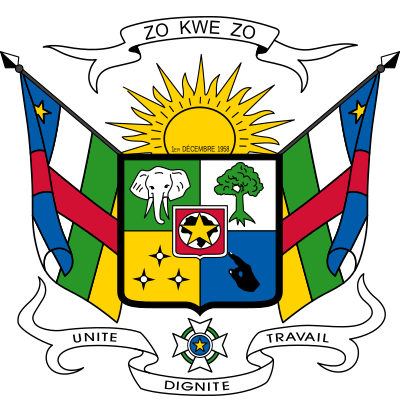
UTC+01:00Coat of Arms
The Flag of the Central African Republic
The Central African Republic, or CAR, is a country in Central Africa. It is bounded by Cameroon, Chad, Sudan, South Sudan, the Democratic Republic of the Congo, and the Republic of the Congo. Its flag is composed of four horizontal stripes, each of a different color, and a smaller vertical band in its center.
What Does the Central African Republic Flag Look Like?
The flag of the Central African Republic is composed of four horizontal stripes, each of a different color. The upper stripe is blue, the second stripe is white, the third stripe is green, and the bottom stripe is yellow. In the center of the flag is a vertical band of red, which is bordered by two white pentagram stars.
What is the Central African Republic Flag Called?
The flag of the Central African Republic is commonly known as the “Bangui Flag”, named after the capital city of Bangui.
What Does the Central African Republic Flag Represent?
The flag of the Central African Republic has multiple symbolic meanings. The blue stripe represents the sky and hope, the white stripe stands for peace, the green stripe symbolizes the country’s natural wealth, and the yellow stripe represents the sun and the country’s bright future. The two white pentagram stars on the red band represent the country’s dedication to human rights and democracy. Lastly, the red band itself stands for the nation’s courage and its struggle for independence.
Who Created the Central African Flag?
The Central African Republic flag was designed by Barthélémy Boganda, who is widely regarded as the father of the country. He was an educator and politician from the Central African Republic, and was instrumental in the country's independence in 1960.
Boganda was born in 1910 in the small village of Bembe in the Oubangui-Chari region of what was then French Equatorial Africa. After completing his education, he became a teacher and became involved in the struggle for independence. He was the founder of the Social Democratic Party, which was the main political force for independence and autonomy in the country.
The Central African Republic flag was designed by Boganda in 1958, before the country's independence. It features a yellow star on a vertical red stripe, with a blue background. The yellow star is a symbol of hope and unity, representing the country's hope for a bright future. The red stripe stands for the blood shed during the struggle for independence, and the blue stands for the sky and sea of the Central African Republic.
Boganda was also instrumental in the adoption of the Central African Republic's current national anthem, which he wrote in 1958. The anthem, titled "La Renaissance," was adopted officially in 1960, the same year the country gained independence. It speaks of the country's struggle for independence, and its hope for a bright future.
Boganda was a gifted and passionate leader, and his legacy still lives on today. He was a major figure in the independence of the Central African Republic, and his influence is still evident in the national flag, anthem, and other aspects of the country. His legacy will continue to be remembered for many years to come.
The Colours of Central African Republic
Bordering Countries


Similar Flags
Flags that share colours with Central African Republic